
International Day of Awareness of Food Loss and Waste
While people go hungry, we waste 1/3 of the food we produce:
5 facts about food waste and hunger – World Food Programme
Global hunger isn’t about a lack of food. Right now, the world produces enough food to nourish every child, woman and man on the planet.
But nearly a fifth of all food produced each year is squandered or lost before it can be consumed.
In many rich countries, this food waste happens in the kitchen—when we prepare food that goes uneaten or leave it to spoil in fridges and kitchen cabinets.
For millions of people in developing countries, this food waste happens at harvest time. Poor storage facilities on farms lead to pest infestations and mould ruining crops. Limited access to technology and markets forces many farmers to watch their crops rot in the fields because they often lack the labour and financial resources needed to harvest them.
Along with chronic poverty, conflict and economic shocks, food loss is one of the root causes of hunger worldwide. Food loss also represents a waste of the very resources used to produce food — such as land, water and energy.
Here are some basic facts (source: UNEP Food Waste Index Report 2024):
1. One-fifth of food produced for human consumption is lost or wasted globally. This amounts to one billion meals a day.
2. The total cost of food loss and waste for the global economy is estimated at roughly US$1 trillion.
3. Food loss and waste generates up to 10 per cent of global greenhouse gas emissions – almost five times the total emissions compared to the aviation sector.
4. Sixty percent of food waste happens at household level.
5. Food waste is higher in hotter countries, both at the household level and in the post-harvest phase, with high temperatures affecting storage, processing and transportation of food.
Food waste, methane emissions and global warming
Food waste decays quickly, producing methane emissions in landfills. In fact, it contributes to as much as 14% of global methane emissions. Methane is a powerful greenhouse gas (GHG), far more potent than carbon dioxide (CO2) over shorter timescales, and a major driver of global warming. The result is rising pressure on ecosystems and agriculture alike, through shifting habitats, changing species ranges, and intensifying drought, wildfires, and extreme heat.
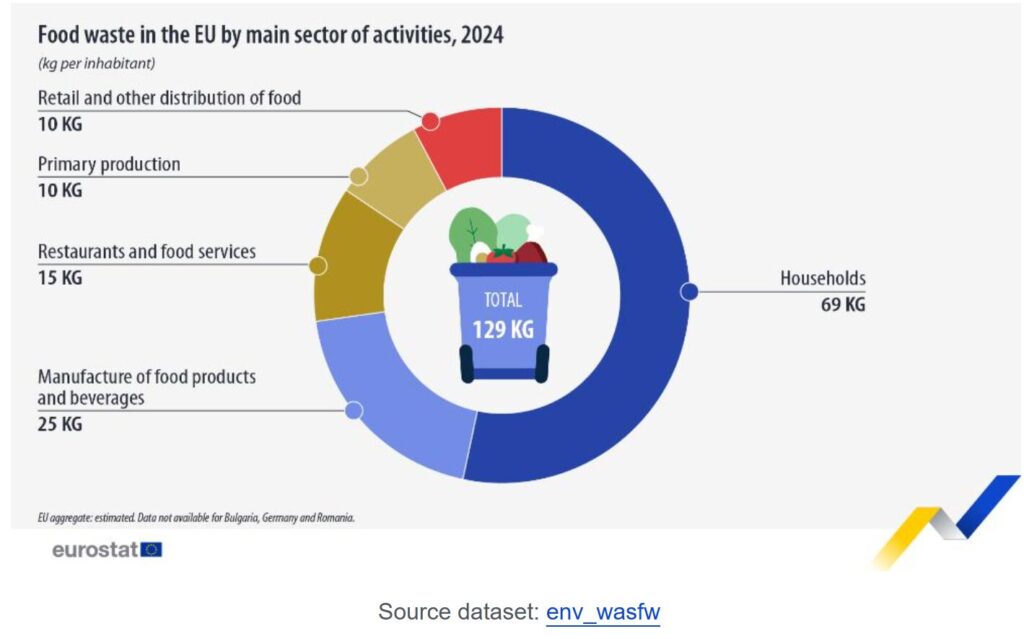
eurostat: In 2024, around 129 kilograms (kg) of food waste was generated per person in the EU.
In total, the EU generated 57.9 million tonnes of food waste, including both edible and inedible parts, indicating a slight increase of 0.7% compared with 2023 (57.5 million tonnes).
Household waste accounted for more than half of all food waste (53%), amounting to 69 kg per person, and another 12% was generated by restaurants and food services (15 kg per inhabitant). The remaining 35% was generated at earlier stages of the food supply chain: 19% was generated by the manufacture of food products and beverages (25 kg per inhabitant), and 8% each by primary production and retail and other distribution of food (10 kg per inhabitant each).
For more information
- Statistics Explained article on food waste and food waste prevention – estimates
- Thematic section on waste
- Database on waste
- Reducing Food Waste in the EU: Q&A
- Statistics for the European Green Deal dashboard
Methodological notes
- The Waste Framework Directive 2008/98/EC (updated by the amending Directive (EU) 2025/1892 on waste) establishes an annual reporting obligation on measurements of the levels of food waste by sector of activity according to the statistical classification of economic activities in the European Community (NACE rev. 2) and by households. The Commission delegated decision (EU) 2019/1597 defines the common methodology and minimum quality requirements for the uniform measurement of levels of food waste and the Commission implementing decision (EU) 2019/2000 provides the reporting format.
- Data are not available for Bulgaria, Germany and Romania for the 2024 reference year. Eurostat has estimated the EU aggregates on the basis of all EU countries; for countries without 2024 data, the latest available figure was used.
- Food waste consists of parts of food intended to be ingested (edible food) and parts of food not intended to be ingested (inedible food). Food waste is any food that has become waste under these conditions: it has entered the food supply chain, it has then been removed or discarded from the food supply chain or at the final consumption stage, it is finally destined to be processed as waste.
For information on upcoming releases, visit our release calendar. If you have any queries, please visit our contact us page.

Comments are closed.