
While last year’s “Peace Prize” winner was a sworn bloodthirsty MAGA-Zionist who applauded US bombing of her own citizens and wrote to Netanyahu that she welcomed the Israeli military to intervene in Venezuela, this year’s candidate is quite the opposite. And this year’s decision seems not to have been leaked! Where was Asle Toje? Maybe he is more concerned with cutting Norwegian aid from a world-leading 1.03 percent, which he reads as “a sign of systemic stagnation”, to the UN minimum standard of 0,7 of BNI. Maybe Toje was inspired by Elon and the other oligarchs at Trump’s inauguration to cut in line with the Trump administration’s cut to USAID?
There has long been a political majority in favor of Norway providing 1% of its income in aid.
The Nobel Peace Prize for 2026 goes to a person who, with exceptional courage and integrity, has led the way towards a more comprehensive global legal order. This year’s laureate has been instrumental in ensuring that war crimes, crimes against humanity and genocide are prosecuted.
Hours after the award was announced in Norway, the Trump administration imposed sweeping new sanctions on the International Criminal Court as part of its campaign to dismantle the tribunal over investigations into the United States and its allies, including Israel. – AP News
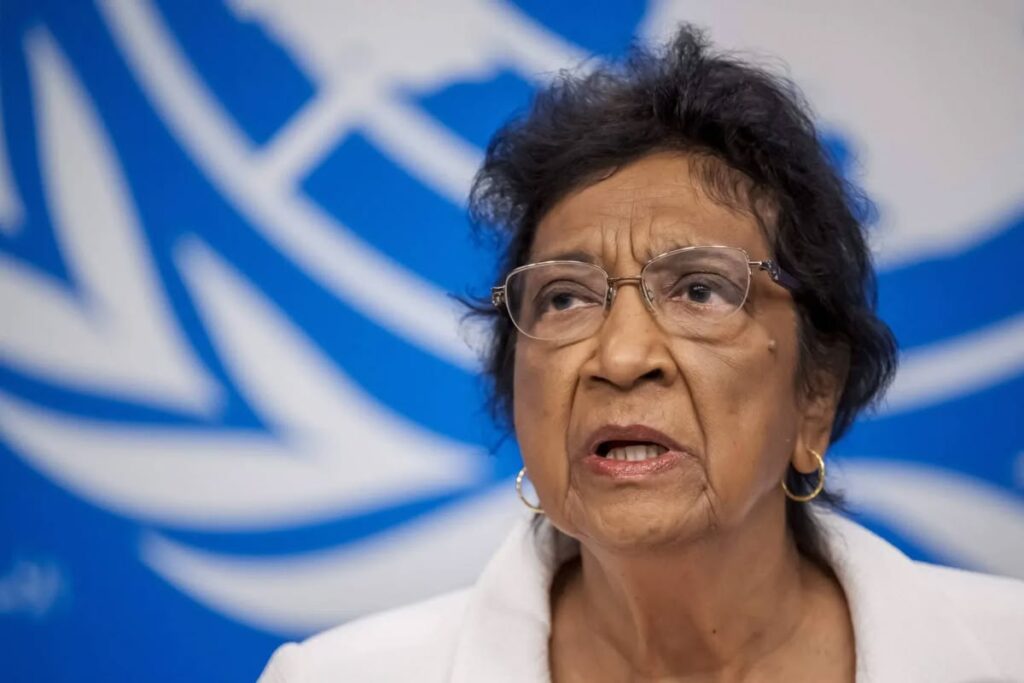
Navi Pillay’s commitment to universal legal principles and her firm moral compass are constants in a long career. Born into a family of Indian Tamil origin under apartheid in Durban, South Africa, Pillay became a lawyer and legal pioneer, confronting deep structural discrimination, segregation and exclusion. A common thread runs from her early work defending Nelson Mandela and others who stood up against apartheid to her service as a judge in some of the key international court cases of our time
This year’s laureate has significantly enlarged the scope and impact of international law. She has served as a judge on the High Court in South Africa, the International Criminal Tribunal for Rwanda and the International Criminal Court. She was the United Nations High Commissioner for Human Rights and, until recently, she chaired the UN Independent International Commission of Inquiry on the Occupied Palestinian Territory. Today, Navi Pillay is a judge on the International Court of Justice in the case where Myanmar stands accused of genocide. [and Telenor got involved].
In historic international court cases, she has shown that legal measures can help prevent acts of war and violence. Navi Pillay has also contributed to strengthening the institutions of international law. Her independence, expertise and steadfastness have made her one of the most respected international jurists of our time.
The first Nobel Peace Prize was awarded 125 years ago. Already then, the Norwegian Nobel Committee underscored the importance of resolving conflicts through international law – a theme that has remained prominent throughout the history of the Peace Prize. The reach of international law expanded after the Second World War, in particular with the creation of the UN institutions. The key insight was that lasting peace must be built on legal principles, not on the will of the strong or a fragile balance of power. Additional legal mechanisms were introduced in the post-war decades, and momentum picked up further after the end of the Cold War
However, the rules-based international order has never been perfect. The greatest powers have often evaded responsibility. In practice, cases brought under international law have produced different results depending on who is the perpetrator and who is the victim.
Nonetheless, we have seen that more and more conflicts are being addressed through diplomacy, treaties and legal mechanisms, rather than threats, violence and warfare. Leaders and populations alike have come to the same conclusion: international law is a foundation for a more peaceful world.
At a time of existential challenges – including more wars and conflicts than the world has seen in a long time – international law is no longer just a supplement to peace and security. It is an absolute necessity.
And yet, the system of international law is under tremendous pressure, and its institutions are under attack. We see a shift towards power politics at the expense of legal frameworks and global respect for law and justice. Whenever might overtakes right, it undermines stability, trust and peaceful co-existence.
In awarding this year’s Nobel Peace Prize, the Norwegian Nobel Committee wants to remind the world that the rule of law – national and international – underpins the system we have set up to ensure peace and resolve conflicts non-violently. Peace requires justice
History has shown that a world operating without the rule of law is unjust, unwise and inhumane. The judges – those who guard the thin red line between order and chaos – are therefore highly deserving of our praise. But today, as these same judges are sanctioned, and their institutions are attacked, we need people of courage, vision and determination – qualities that Navi Pillay demonstrates in her work on the bench
Navi Pillay has held states and national leaders accountable and brought hope to victims of violence and conflict. In all the positions she has held, she has stressed the responsibility of individuals and states to comply with the rule of law. She has also helped define the relevant norms and legal principles. When the International Criminal Tribunal for Rwanda established that rape and sexual violence could constitute a crime against humanity – as well as genocide – her influence was a significant factor. In the same case, Ms Pillay was instrumental in a separate legal breakthrough: for the first time, a defendant faced charges of incitement to commit genocide purely based on spreading propaganda
The Nobel Peace Prize for 2026 springs directly from Alfred Nobel’s will. Navi Pillay strengthens fraternity between nations and – by systematically advancing the use of tribunals for peace and justice – she provides substance, direction and motivation for peace conferences in their modern form.
Navi Pillay is one of the great defenders of international legal principles in our time. Her distinguished career reminds us of the need to support, fortify and expand the global rule of law. Navi Pillay’s commitment to justice and human dignity is a source of hope and inspiration to all who seek to bring about a more peaceful world.
Peace dove takes flight
At exactly 12:00, a peace dove flew from the windows of the Nobel Peace Center, symbolically marking the moment the world welcomed a new Nobel Peace Prize laureate. Astro Bunn and Ardian Kristiansen Seferaj from Save the Children’s Peace Prize Party Committee, who are preparing a celebration in honour of the Nobel Peace Prize laureate in Oslo on 10 December, helped send the dove on its way.
“It is important that those who break the law are held accountable,” they said. “Children never start wars, but they are often the victims.”
Educational resources ready on Monday
When school bells ring on Monday morning, digital educational resources about the new Nobel Peace Prize laureate will also be ready for use, both in Norway and internationally. The Nobel Peace Center’s education team is developing dedicated teaching resources on this year’s Nobel Peace Prize, adapted for different age groups.
As Navi Pillay wins the Nobel Peace Prize, the US takes unprecedented action to cripple the court she served on
When South African jurist Navi Pillay won this year’s Nobel Peace Prize, she happened to be at a conference at the Nuremberg Court in Germany, where the landmark trial of Nazi leaders almost 80 years ago laid the foundations for modern international law.



Comments are closed.