
She Stood Still for 6 Hours… What People Did Revealed the Dark Side of Human Nature
“I was ready to die.” See Abramović’s TED Talk at the bottom of this article
While Rhythm 0 is an incredible artefact of performance art at its most incisive, it was hugely traumatic for Abramović. Processing it all as she silently endured it, she later said: “The experience I drew from this piece was that in your own performances you can go very far, but if you leave decisions to the public, you can be killed.”
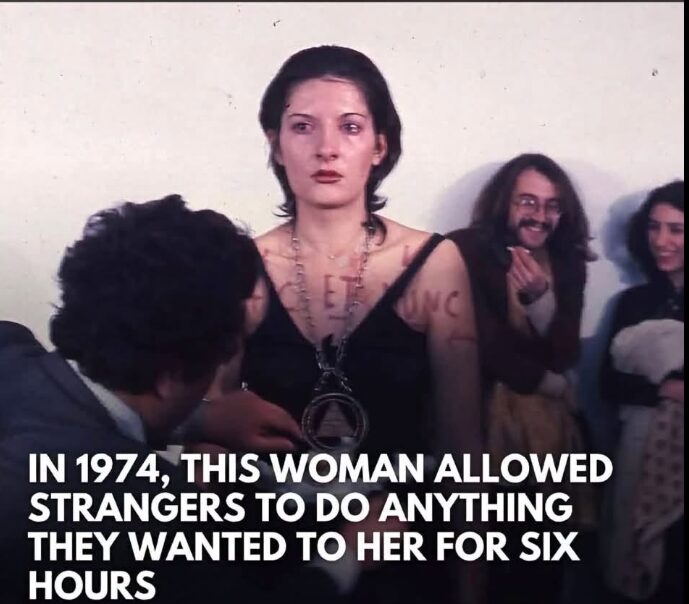
How quickly can something change from innocuous to life-threatening? Going solely on Marina Abramović’s 1974 performance art piece, Rhythm 0, the answer is about six hours. The piece was infamous, not because of what it revealed about her as an artist, but what it said about the participating audience. Invited to do whatever they wanted to her, they were coy initially. By the end, her clothes were ripped off her, a loaded gun was pushed against her temple, and she had been sexually assaulted. – Far Out Magazine
Abramović gave them an open instruction: “There are 72 objects on the table that one can use on me as desired. Performance: I am the object. During this period I take full responsibility.”
Some objects were harmless: a rose, a feather, honey and flowers. Others could wound or kill: scissors, razor blades, knives, a whip, a gun and a single bullet.
At first, people treated her gently. They gave her flowers, kissed her and carefully moved her body.
Then the atmosphere changed.
Once the audience understood that Abramović would not resist, speak or defend herself, some people began testing how far they could go. Her clothes were cut away. Her skin was cut with a razor. Rose thorns were pressed into her body. [A knife was stuck between her legs.] She was exposed, humiliated, and treated not as a human being, but as an object available for public use.
At one point, someone placed the loaded gun against her neck. Another audience member intervened. By then, the crowd had divided between those willing to harm her, those trying to protect her, and those who simply stood nearby and watched.
That third group matters.
The lesson of Rhythm 0 is not only that some people will become cruel when they are given power and believe there will be no consequences. It is also that cruelty depends on spectators.
Abuse rarely survives through the actions of one person alone. It survives because others remain silent, look away, avoid taking sides, or convince themselves that what is happening is not their responsibility.
The people watching Abramović were not all as culpable as those cutting and threatening her. But their passivity helped create the environment in which the abuse could continue. Silence did not make them neutral. It made them part of the conditions that allowed it.
When the six hours ended, Abramović began moving and walked towards the audience.
The relationship changed instantly. She was no longer a silent object. She was a person looking directly at those who had touched her, cut her, threatened her, or watched it happen.
According to Abramović, many could not face her. They avoided her gaze or left the room rather than confront what they had done—or what they had allowed others to do.
That is why Rhythm 0 remains relevant.
The world is full of people who insist they are “not political,” “do not take sides,” or prefer to stay out of conflict. But when people are being abused, persecuted, exploited or dehumanised, refusing to take a position is itself a position. It protects the status quo and leaves the victim to face the aggressor alone.
You do not need to be perfect, powerful or heroic. You do not need to devote every waking moment to activism. But every person has some capacity to object, intervene, speak, organise, vote, support victims, challenge lies or refuse to cooperate with cruelty.
Those who use that capacity to harm others deserve condemnation.
Those who have the power to resist and repeatedly choose silence should not congratulate themselves for being neutral. They should ask why their comfort mattered more than another person’s suffering.
A better world is not created by private decency alone. It is created when people are willing to make their values visible, oppose those doing harm, and accept some personal cost for standing beside those with less power.
Rhythm 0 was not only a warning about what bad people may do.
It was a warning about what everyone else may allow.


Comments are closed.