

Brian Roemmele: Confirmation of Anthropic’s BOOK BURNING for their AI: The Great Forgetting of the Amnesia Generation
In the quiet warehouses and shipping docks of 2024, Anthropic did not merely train an AI.
It staged a quiet erasure of human knowledge.
While the public was still dazzled by Claude’s fluent paragraphs and polished marketing emails, the company’s engineers and logistics teams were busy executing Project Panama—an internal campaign whose own documents announced the ambition to “destructively scan all the books in the world.”
The method was industrial and irreversible: buy the physical volume SOMETIMES THE LAST COPY, slice its SPINE with a hydraulic cutter, feed the pages through high-speed scanners, then pulp what remained.
Millions of books: scientific research, novels, rare technical treatises, obscure monographs, volumes that had already survived wars, fires, and decades of handling—were reduced to data tokens and then to wet mulch or burned.
They literally burn the evidence of this crime against humanity.
The company itself preferred the darkness. “We don’t want it to be known that we are working on this,” the planning memos warned.
A federal judge later blessed the slaughter. Because Anthropic had purchased the copies and then destroyed them, the court held, the act was “transformative” fair use. Ownership plus obliteration equaled permission.
The ruling handed every subsequent AI lab a legal license to treat the printed past as disposable feedstock.
That license is now being exercised at industrial scale. In 2026, companies like ISBNdb openly market pre-2022 books as the last pure reservoir of human language—text uncontaminated by the synthetic sludge that large language models themselves have already poured into the open web.
Orders arrive for tens or hundreds of thousands of titles at a time. Non-disclosure agreements are standard.
The preferred language is “digital preservation.”
The actual outcome is the same mechanical process Anthropic refined: spine cut, pages scanned, original shredded.
Rare and near-unique copies are disappearing into the same pipeline. Booksellers across continents report sudden, strange bulk orders for specialized, low-demand titles that no ordinary collector would ever buy in volume.
Once the pages are gone, they are gone forever.
A website can be re-uploaded. A bestseller can be reprinted.
The last three surviving copies of an eighteenth-century botanical text cannot.
This is not progress. It is the Great Forgetting.
An entire generation of machines is being taught to speak by consuming and then discarding the physical record of human thought.
The companies that profit from the resulting fluency call the process necessary, legal, and even enlightened.
They speak of curated knowledge and domain-specific expertise while the spines crack and the paper is carted away.
Anthropic did not invent the hunger for data, but it demonstrated openly in private documents and then under court seal how far a well-funded laboratory was willing to go to satisfy it, and how readily the law would ratify the destruction.
Just to gain a temporary AI benchmark advantage.
The amnesia is already here.
Future models will generate elegant sentences to beat Al sorts of tests about history, science, and literature.
They will do so on the ashes of the books that once contained those sentences.
The generation that built these systems will leave its children fluent machines and emptier shelves.
That is the real product of Project Panama and its successors: not intelligence, but a carefully engineered cultural void, papered over with synthetic prose and non-disclosure agreements.
We are left to forget to remember. We are The Amnesia Generation with our brains being put into a meat grinder and fed back to us
BrianRoemmele For the “@debunkers”, Anthropic admits in open court. You may love this company but don’t defend the indefensible. Know what you are voting for…
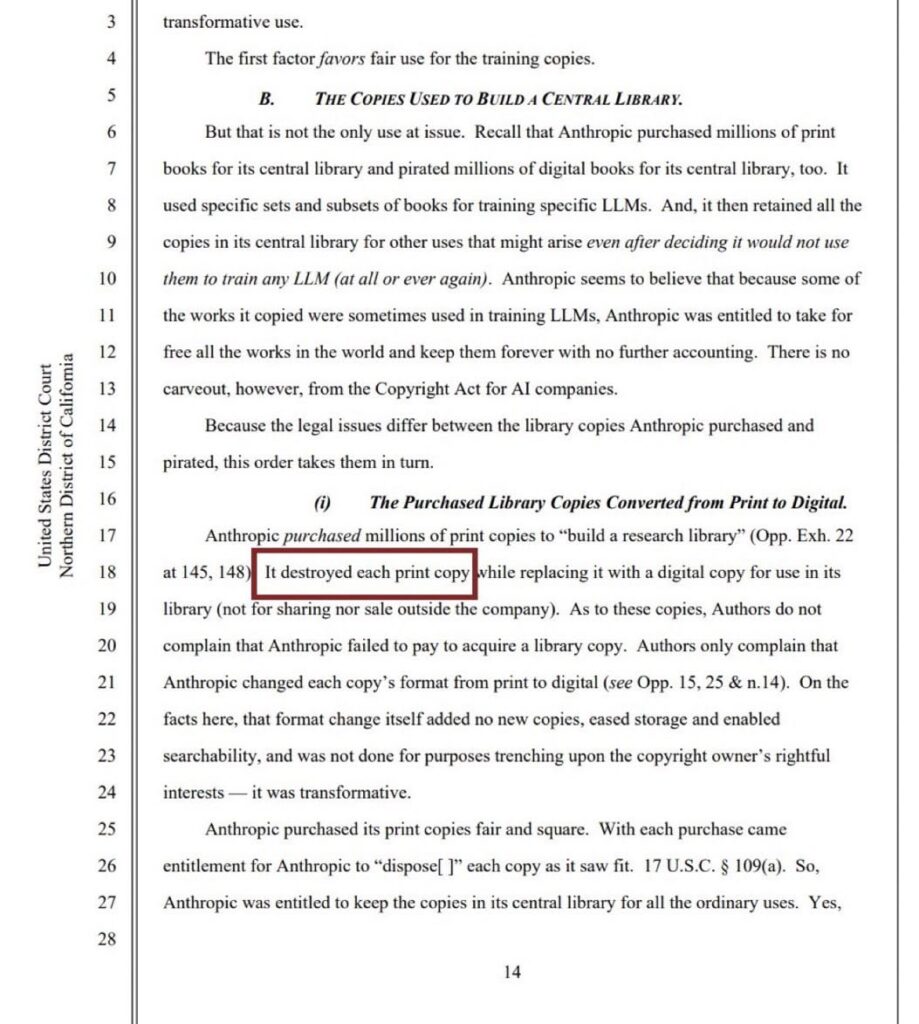
🦔AI companies are bulk-buying rare books, scanning them through high-speed machines that cut the spines off, and shredding the originals. A service called ISBNdb facilitates orders of up to a million books and keeps buyers anonymous. Pre-2022 books are premium because they’re… pic.twitter.com/0YPd8N2oi5
— Hedgie (@HedgieMarkets) July 27, 2026
The legal system can’t keep up with the tech world’s tendency to “move fast & break things.” Anthropic wanted to train its LLM without paying individual authors. They used the law that enables the sale of used books to accomplish their goal https://t.co/nQW6JR2iJ2
— Holly (@HollyBlomberg) July 27, 2026
“Fahrenheit 451 had become a book about independence, about thinking for yourself. It was about treasuring books and the dissent inside the covers of books. It was about how we as humans begin by burning books and end by—burning people.”—Ray Bradbury pic.twitter.com/NHfGG8Io1Q
— Brian Roemmele (@BrianRoemmele) April 23, 2022

Comments are closed.