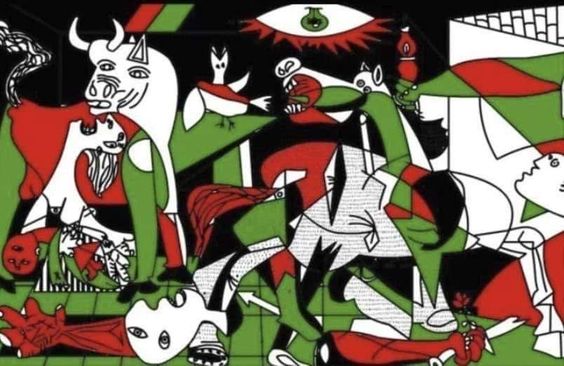
How fucked has the world become when it’s “radical” to be against an ongoing genocide? – Helene Hestad (@helene.hestad)

The Metropolitan Police said 523 people aged between 18 and 87 were arrested for protesting genocide and showing support for Palestine Action during a demonstration at Trafalgar Square in London on April 11, 2026. itvNEWS
Those arrested included Massive Attack musician Robert Del Naja, who sat with an “I Support Palestine Action” sign and was later carried away by three police officers.
Israel Exposed — War Crimes Archive https://archivegenocide.com
Witnesses of Atrocities and Genocide
We archive what others erase. Permanently.
We are a group of researchers dedicated to archiving war crimes footage from Gaza and the West Bank. Our team submits all evidence to the International Criminal Court (ICC), the Hind Rajab Foundation, and the South African legal team at the ICJ.
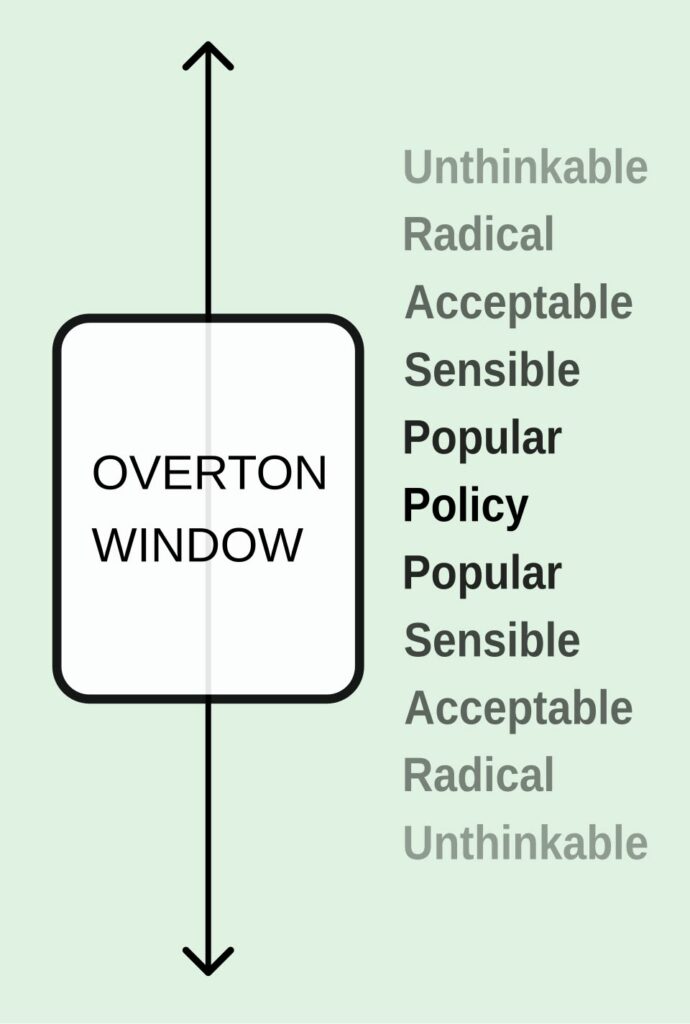
The Overton window, a once-niche academic political science concept, has become a key concept used to explain the rise of Donald Trump and Brexiteers, and is important to understanding how the winds of political discourse change. CONCEPTUALLY
Wikipedia: The Overton window is the range of subjects and arguments politically acceptable to the mainstream population at a given time.[1] It is also known as the window of discourse.[2] The key to the concept is that the window changes over time; it can shift, shrink, or expand.[3] It exemplifies “the slow evolution of societal values and norms”.[3]
The term is named after the American policy analyst and former senior vice president at the Mackinac Center for Public Policy, Joseph Overton, who proposed that the political viability of an idea depends mainly on whether it falls within an acceptability range, rather than on the individual preferences of politicians.[3][4] According to Overton, the window frames the range of policies that a politician may recommend without appearing too extreme, to gain or keep public office, given the climate of public opinion at that particular time.[5]
In order to explain what think tanks do, in the 1990s he designed a brochure to illustrate the range of policies politically acceptable to the mainstream at a given time.[8] That idea eventually became known as the Overton window, and his lasting legacy.[4] He opined that it is the responsibility of think-tanks to propose policies outside the window and shift the window.
The Mackinac Center for Public Policy is a conservative think tank headquartered in Midland, Michigan.[3][4][5][6] It has been variously described as free market,[7][8] conservative,[9][10] and fiscally conservative.[11][12] Through research and programs, the Mackinac Center supports lower taxes, reduced regulatory authority for state agencies, right-to-work laws, school choice, and property rights.[13][6]
Overton described a spectrum from “more free” to “less free” with regard to governmental intervention, which he presented graphically on a vertical axis to avoid comparison with the left-right political spectrum.[6] As the spectrum moves or expands, an idea at a given location on the scale may become more or less politically acceptable. Overton claimed that politicians typically act freely only within the “window” of those seen as acceptable. After his death, his Mackinac Center for Public Policy colleague, Joseph Lehman, further developed the idea and named it after him.[7]
The political commentator Joshua Treviño has postulated six degrees of acceptance of public ideas: “roughly”[8]
- unthinkable
- radical
- acceptable
- sensible
- popular
- policy
On this basis, the Overton window comprises the politically possible ideas: those in the lower part of the list, from acceptable downward. Proponents of policies outside the window may then seek to expand the window, by highlighting their own proposals or others similar to them (or more extreme), or to shift the window by devaluing opposed ideas. Proponents of current policies, or similar ones within the window, might attempt to narrow the window by convincing people that policies outside the status quo should be deemed unacceptable.
In November 2006, The New York Times published a two-part series about state-based “conservative” think tanks that described how the Mackinac Center trained think-tank executives from 42 countries and nearly every US state. The New York Times also reported that, “When the Mackinac Center was founded in 1987, there were just three other conservative state-level policy institutes. Now there are 48, in 42 states.”[9]
Opinion corridor (from Swedish åsiktskorridor, norsk meningskooridor) is a metaphor for the boundaries of what opinions are considered acceptable to promote in public debate.[1] The term refers to what is considered to be generally accepted opinions, and which expressions lead to the risk of condemnation and ostracism from “good company”. The term is particularly used to describe political opinions that are widespread in the population, but rarely promoted in established media.
The term was introduced by political scientist Henrik Oscarsson in 2013.[2]
Polarization. Shattering the Overton Window. What began as a framework for understanding social change became a blueprint for engineering it. As political actors systematically push the boundaries of acceptable discourse, they transform radical ideas into mainstream conversations. This isn’t about genuine ideological debate, but about deliberately fragmenting social consensus. Each provocative statement serves to polarize rather than unite, effectively preventing meaningful collective action or understanding. – Natalia Antelava,CEO and Editor-in-Chief at Coda
The Overton window is decentralized and highly polarized, split into two distinct, clashing trajectories. Progressive social policies, like systemic economic reforms and climate action, dominate younger demographics and cultural discourse, while right-wing populist ideas regarding immigration, nationalism, and state power increasingly dominate formal political and government policy. [1, 2, 3]
Because society is deeply segmented, the boundaries of acceptable political discourse differ sharply depending on geography, culture, and the specific issue in question. In the US, for instance, progressive ideas like universal healthcare have shifted into mainstream debate, while conservative pushbacks on DEI and public education occupy the center of institutional politics. Globally, the rise of far-right and populist movements has continually stretched the window to include nationalistic and anti-globalist policies once considered unthinkable. [1, 2, 3, 4, 5]
To see where the window sits in your immediate area on a specific issue, explore current Pew Research Center public opinion trends or analyze the latest localized polling available on Gallup.
When the Prime Minister talks about deporting criminal foreigners regardless of their affiliation with Denmark, it is a good example of the Overton Window moving sharply towards the extreme right.




Comments are closed.