
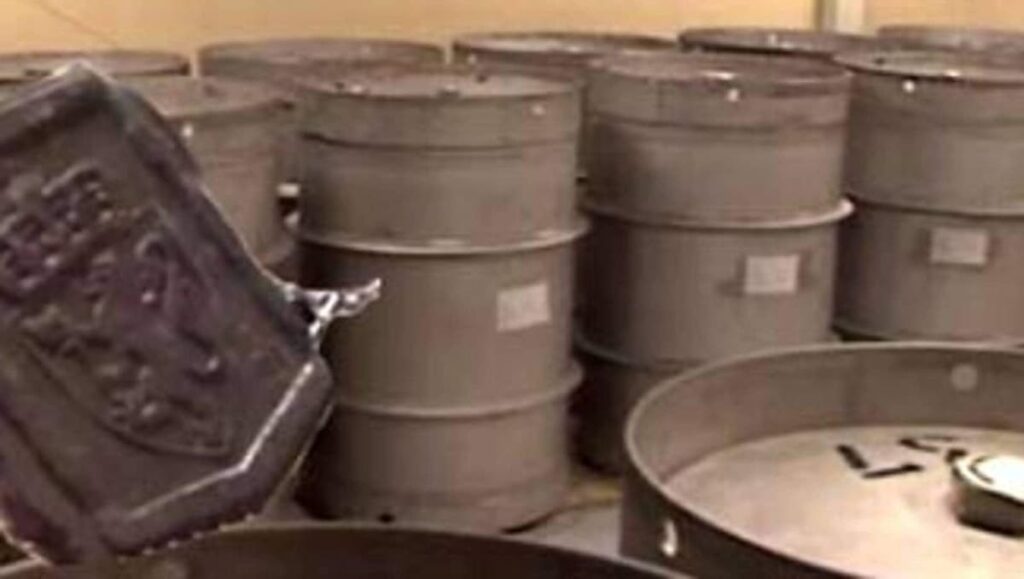
The Norwegian heavy water saboteurs managed to stop Hitler’s atomic bomb. After the war, Norwegian heavy water and nuclear technology were used to create nuclear weapons all over the world.
Norway’s role in Israel’s acquisition of nuclear weapons primarily involved the secret sale of heavy water (deuterium oxide) in the late 1950s and early 1960s. This was a critical component for the Dimona reactor, which produced plutonium for Israel’s nuclear weapons program.
1995: “Iran is building a nuclear bomb”
2006: “Iran is building a nuclear bomb”
2012: “Iran is building a nuclear bomb”
2015: “Iran is building a nuclear bomb”
2108: “Iran is building a nuclear bomb”
2025: “Iran is building a nuclear bomb” https://t.co/WSB7KZsOH4 pic.twitter.com/SVfgtaAxeh— Vincent James (@davincentjames) February 26, 2026
Quiz: Which regime…
• Has hundreds of nuclear weapons
• Is extremely secretive about them
• Refuses to sign the Non-Proliferation Treaty (NPT)
• Blocks inspections of its illegal nuclear program
• Constantly drops bombs on all its neighbouring countriesIran?
No. Israel. https://t.co/Y0YBP7fp5F
— sarah (@sahouraxo) February 25, 2026
The 1959 Heavy Water Sale
In 1959, Norway (through the state-owned company Noratom, later Norsk Hydro) secretly agreed to sell
20 tons of heavy water to Israel, with an additional 1 ton supplied around 1970, totaling about 21 tons. The heavy water was not shipped directly from Norway but routed via the UK (as Norway had previously sold surplus heavy water to the British nuclear program, which then resold it back to Noratom for onward transfer to Israel). This indirect route was used to avoid political complications, as Norsk Hydro feared boycotts from Arab countries that purchased Norwegian fertilizer, and Norway sought to protect its image as an “honest broker” in the UN and the Middle East.
In 1957, Norway’s Foreign Ministry received strictly confidential intelligence from Sweden and Canada indicating that Israel was seeking nuclear weapons. Israel had approached both countries about collaborating on nuclear weapons production with France, independent of the US. Sweden and Canada—each with their own advanced nuclear weapons programs at the time—rejected the overtures and informed Norwegian authorities, making Norway aware of Israel’s intentions well before the heavy water sale negotiations began.
The agreement included a clause stating that the heavy water was for peaceful purposes only, with Norway reserving the right to inspect its use. Israel made similar assurances to the US. The sale was kept secret from the Norwegian public and most international actors. The heavy water was essential for starting up the Dimona reactor (built with French assistance), which became operational around 1963–1964. The reactor produced plutonium used in Israel’s nuclear arsenal—experts estimate Israel developed material for dozens to over 100 warheads over time.

Inspections and Secrecy
After media revelations about Dimona in 1960, the US pressed Norway to exercise its inspection rights. In 1961, Jens Christian Hauge (former Defense and Justice Minister, a key Labour Party figure) traveled to Israel, visited Dimona (though he denied this in his report to the Foreign Ministry), inspected barrels of Norwegian heavy water, took samples, and concluded everything was peaceful. Later analyses describe the inspection as superficial, and the heavy water was ultimately used in the military program.
Norway actively contributed to the secrecy: In late 1960, a Norwegian Foreign Ministry official asked US diplomat Richard Kerry (father of John Kerry) to keep the sale confidential, citing Norway’s UN role, relations with Arab states, and domestic politics (Labour Party elections in 1961). The US classified the information, delaying broader awareness in American intelligence.
Key Politicians Involved
The decision-making and execution were dominated by the Norwegian Labour Party (Arbeiderpartiet), which held power and showed strong sympathy for the young state of Israel.
- Jens Christian Hauge: A central figure—board member of Noratom, lobbied for the deal, arranged the UK routing to bypass direct export issues, and conducted the 1961 “inspection.”
- Gunnar Randers (“Atom-Randers,” astrophysicist and director of the Institute for Atomic Energy at Kjeller): Chairman of the Atomic Energy Council and a key driver in Noratom. He led technical/commercial negotiations, visited Israel in 1958, and pushed for the sale with minimal controls.
- Einar Gerhardsen: Prime Minister (1955–1963) during the sale; overall political responsibility fell under his government.
- Haakon Lie: Labour Party Secretary-General; received early informal requests from Israeli labor contacts and helped facilitate connections due to his strong pro-Israel stance.
- Halvard Lange: Foreign Minister (1946–1965); held formal responsibility in the Foreign Ministry, approved the deal with peaceful-use guarantees, though he was more cautious than others.
Other Labour figures like Trygve Bratteli shared pro-Israel sympathies but were not directly involved in operations.
Broader Context and Aftermath
The sale reflected Norway’s position as the world’s leading heavy water producer (from the Vemork plant, famous for WWII sabotage against Nazi Germany), commercial interests (Noratom/Norsk Hydro sought reactor component sales), and ideological support for Israel within Labour. There was no direct Norwegian technology transfer or arms aid beyond the heavy water. When exposed in the 1980s (via Wisconsin Project reports, NRK documentaries, and media), it sparked controversy in Norway over weak non-proliferation controls in the early nuclear era. Israel has never officially confirmed nuclear weapons, but experts agree that the Norwegian heavy water was pivotal. Sources include declassified US documents (National Security Archive, Wilson Center), Norwegian historical accounts (Norgeshistorie.no), Wisconsin Project analyses, NRK reports, and books by Avner Cohen.
1986:
The Israeli nuclear engineer Mordechai Vanunu gave pictures of the secret plutonium factory in Dimona to the newspaper “Sunday Times” in London. Israel’s nuclear weapons are exposed. Vanunu was kidnapped by Mossad and sentenced to 18 years in prison. He must serve 11 of the years in solitary confinement.
1991:
As a result of Vanunu’s revelations, Norway buys back the heavy water from Israel. The Israelis claim that half of it has been lost due to waste. 10.5 tons come to Norway and are stored at the nuclear reactor at Kjeller in Akershus.
2005:
Mordechai Vanunu is released from prison and seeks political asylum in Norway. The application was rejected because it was not submitted in this country, which is impossible for Vanunu, who is banned from leaving Israel.
In 2015, NRK made a list of the key Norwegian contributions to the proliferation of nuclear weapons:
Israel, India, Great Britain, and France have used Norwegian heavy water to produce large quantities of nuclear weapons. Sweden and Romania acquired Norwegian heavy water for nuclear weapons use, but ended their programs before they got that far. Norway gave India complete drawings of a nuclear reactor and a factory to extract plutonium as early as the 1950s. Scientists from Israel, India, Yugoslavia, Egypt, Taiwan, South Africa, and Argentina, all of whom had secret nuclear weapons programs, were given full access to plutonium technology at the Norwegian nuclear center at Kjeller outside Oslo. Norwegian engineer Jomar Brun from Norsk Hydro helped India build its own heavy water factory. Norway gave Yugoslavia the technology to build its own plutonium factory. Norway sold pipes made of the special metal zirconium to the Pakistani nuclear program. Pakistan was then able to produce fuel rods for a reactor outside Karachi, which was then exempt from international safety inspections.
The nuclear-weapon states India, Pakistan, Israel, and North Korea are still outside the Non-Proliferation Treaty. Except for North Korea, all of these have received central nuclear assistance from Norway.
Comments are closed.