

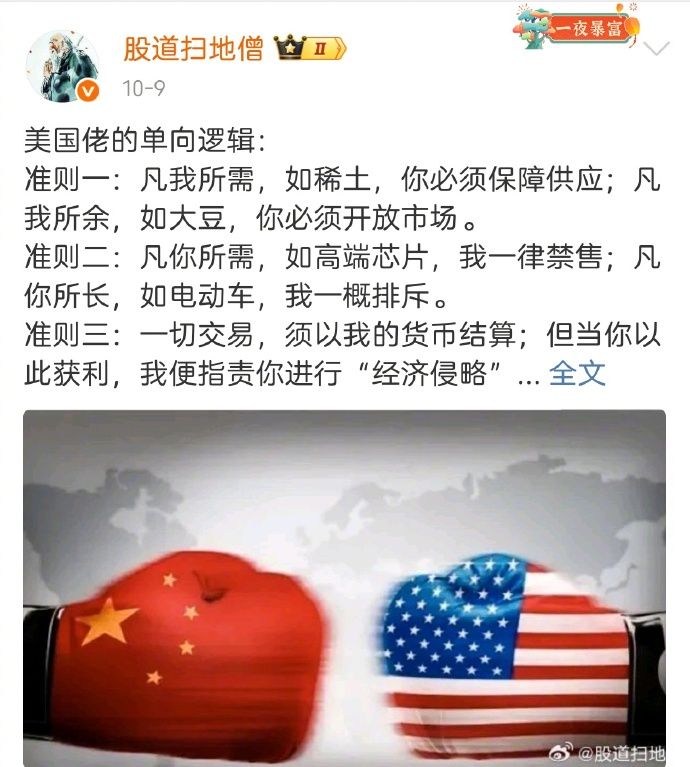
Washington’s “one-way rules”:
A netizen [internet user] has summed up what he calls Washington’s “one-way rules,” a post that has gone viral on Chinese social media. I’ve [ Hu Xijin ] translated it here to see whether American readers would agree.
Rule 1: What I need — such as rare earths — you must ensure the supply of. What I have in surplus — like soybeans — you must keep your markets open for.
Rule 2: What you need — like advanced chips — I will ban entirely. What you’re good at — such as electric vehicles — I will reject outright.
Rule 3: All trade must be settled in my currency. But once you profit from it, I’ll accuse you of “economic aggression.”
Rule 4: When I refuse to trade with you and you turn to others, I’ll charge you with “coercing countries into dependence.” When you expand cooperation, I’ll say you’re “setting debt traps to exploit partners.”
In short, it’s a game built on one principle — the winner never breaks the rules. Buying from you means securing supply; Selling to you means market access. Blocking you is technology protection; Shutting you out is fair competition. Using my dollar is the natural order; Earning my dollar is economic aggression. Becoming self-reliant means coercing partners; Pursuing win-win cooperation means debt traps.
— In short, the right to define the rules is always mine.
The latest foreign trade data released by China has deeply shocked the US and even Western public opinion. From January to September 2025, China-US trade volume reached $425.816 billion, a year-on-year decrease of 15.6%. Of this, China’s exports to the US amounted to $317.225 billion, a year-on-year decrease of 16.9%, while China’s imports from the US amounted to $108.592 billion, a year-on-year decrease of 11.6%. China’s exports to the US fell by 27% in September, marking the sixth consecutive month of double-digit declines. Meanwhile, exports to the EU, Southeast Asia, and Africa increased by 14%, 15.6%, and 56.4%, respectively.
This sends a powerful message: China can offset the decline in US exports by expanding its exports to other regions. The US now accounts for less than 10% of China’s direct exports. This is a milestone achievement in China’s efforts to break free from its dependence on the US market and fully diversify its exports. This is not only economically significant, but also extremely geopolitically significant.
The Trump team’s primary tool for pressuring China remains tariffs, followed by chips, but the situation is rapidly evolving. Against the backdrop of US protectionism, China has strengthened its trade with the rest of the world. China has not recently purchased any US soybeans, and its purchases of US chips have also declined. Domestic substitution is continuously breaking through technological and scale bottlenecks.
Rare earths present a hurdle that Trump cannot overcome. China’s progress in the rare earth sector is not only extraordinary, but its influence is also global and trans-regional. China’s control over rare earths underscores the significant impact it exerts through its monopoly in rare earth mining and refining. China’s rare earth exports fell 30.9% in September compared to August, marking the third consecutive month of decline and the lowest level since February of this year. The urgency of chip manufacturing and the sheer irreplaceability of rare earths are undeniable.
The Trump Admin will ultimately realize the importance and urgency of negotiating a deal with China. What do you do when you know for sure that your weapons cannot effectively harm the other side, but they sting you?
Western CEOs fly to China… and come back terrified not by “authoritarianism”—but by robotic assembly lines that build a truck in 900 meters with zero humans
SHIFTER: Western investors get renewable energy shock after tour of China. In key areas of green technology, such as batteries [Northvolt, Morrow, Freyr], it is pointless for Western startups to compete, they conclude.
It became very clear that we as Western investors are living in a bubble.
– Ashwin Shashindranath, partner at Energy Impact Partners
(a fund in which Nysnø has invested 150 million NOK)

The British Telegraph just published a piece of accidental propaganda for Chinese competitiveness https://telegraph.co.uk/business/2025/10/12/why-western-executives-visit-china-coming-back-terrified/?ICID=continue_without_subscribing_reg_first
Ultimately, the article reveals a simple truth: China is winning the future not through aggression, but through sheer economic and industrial competence. The “terror” experienced by Western elites stems from the growing awareness that the actual “China threat” lies in its successful peaceful development, which has outperformed their own neocolonial model backed by military force.
The “terror” described isn’t of a cartoonish authoritarian villain, but of a reality the West has long denied: China’s industrial and technological ecosystem has achieved a level of scale, sophistication, and velocity that is simply unmatchable by the current Western model.
Ford’s CEO Jim Farley: “Their cost and quality are far superior to the West… If we lose this, we do not have a future at Ford.”
Australian mining tycoon Andrew Forrest? Abandoned his EV powertrain plans after seeing Chinese “dark factories”—fully automated, lights-off, humans optional… The article notes these executives are stunned by the “sheer scale” of everything. From EV factories to the pace of innovation, China operates on a different logistical and mental plane. This is the fruit of long-term planning and systemic integration, not quarterly capitalism Meanwhile, in Britain: BYD sales up 1,000% in a year. Outselling Mini, Renault, Land Rover
The numbers don’t lie: China installed 295,000 industrial robots last year. The US? 34,000. UK? A pitiful 2,500—and down 35% from the year before. The most amusing part? They are shocked by China’s “parallel universe” of supply chains. After decades of offshoring their own industrial capacity, Western elites are “terrified” to discover that the world’s workshop is now also the world’s R&D lab, and no longer needs their blueprints.

This “fear” is the sound of a paradigm shattering.
The West’s cherished narrative of Chinese “copycats” is dead.
The new narrative, as the article hints, is one of awe and anxiety at an ecosystem that can innovate and manufacture at a pace that leaves Western boardrooms and political elites in a cold sweat. So, what are the implications? This first-hand experience of the capitalist class serves as a direct rebuttal to hawkish politicians attempting to “decouple.” You cannot contain what you fundamentally depend on.
The “terrified” executive is the best argument against a new Cold War!
The Netherlands has just crossed a geopolitical Rubicon
By seizing control of the Chinese-owned chipmaker Nexperia, The Hague has aligned itself with Washington in the new Cold War, where semiconductors, data, and rare earths define power hierarchies.
This is no longer just a trade issue but a front in the systemic struggle between the U.S. and the DragonBear bloc. Europe’s most open economy has now accepted that strategic dependence equals major vulnerability.
Next comes the hard part: managing China’s retaliation, securing Europe’s chip supply chains, and preparing for a world split into two competing technological, trade and supply chains ecosystems. The age of neutrality in technology, geoeconomics and geopolitics is over for Europe. – Velina Tchakarova, Geopolitical Strategist, Vienna
FT Exclusive: The Dutch government seized control of chipmaker Nexperia after Washington warned the company would not be removed from its export control list if its Chinese chief executive Zhang Xuezheng remained in charge, according to court filings. https://t.co/JgnO3mVASu pic.twitter.com/UWgzW2XNLW
— Financial Times (@FT) October 14, 2025
Vassal State Poland is doing the vassal’s things

In the words of its first Secretary General, Lord Ismay, Nato’s role is to:
— Harvey Wallbanger (@HarveyWall8angR) October 14, 2025
“keep the Russians out, the Americans in and the Germans under control”. pic.twitter.com/9BFYITGkVx
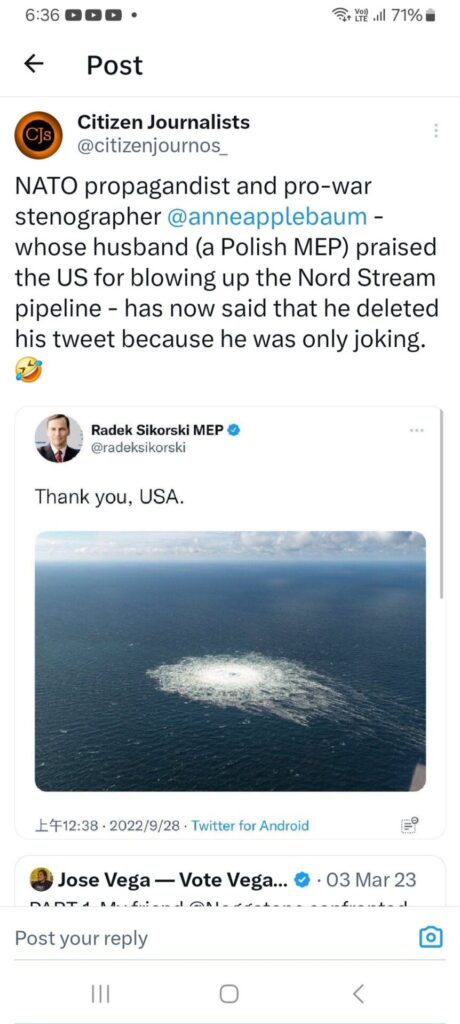
Poland demands Germany stop its Nord Stream investigation. The topic of Nord Stream causes panic within Poland’s political class. Why?
FT: Sławomir Cenckiewicz, who leads Poland’s national security bureau and is a key adviser to President Karol Nawrocki, told the Financial Times… pic.twitter.com/3eIBhKtOtL— Alex Christoforou (@AXChristoforou) October 14, 2025
Poland. Another one bites the dust.
Poland thought it could hold China to ransome by blocking China’s freight train export route into Europe. China now activates the Southern Route into Europe, bypassing Poland. Poland could now incur economic losses of $45million per day. FAFO. pic.twitter.com/Cpxn7qCUFN— Yes, it’s me (@ElysiusThor) October 14, 2025
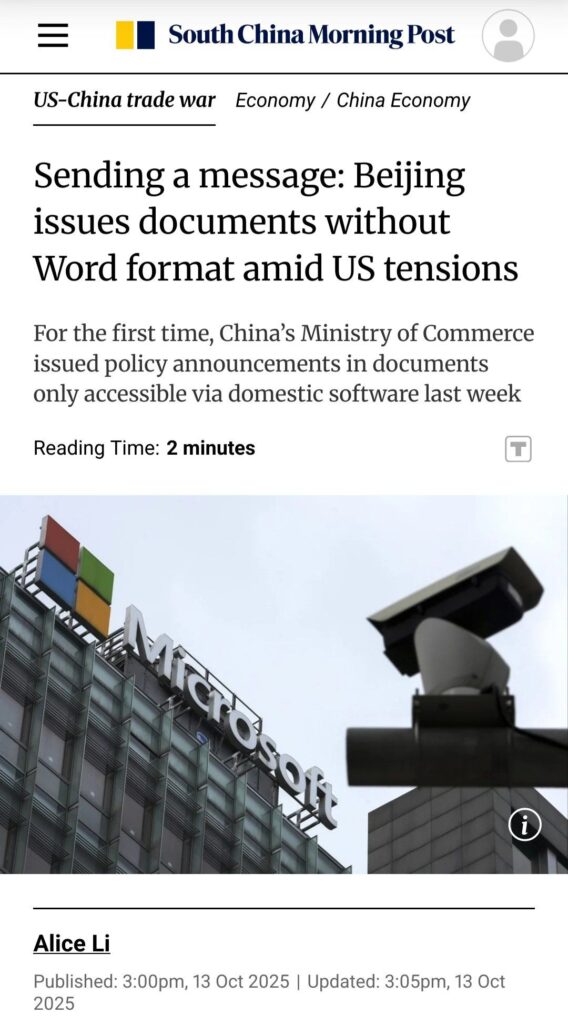
China is challenging Microsoft’s global monopoly
The US government has been so arrogant in its trade war on China (under both Trump and Biden) that it failed to recognize China’s significantly greater leverage. Ben Norton
This is another example: China is now transitioning away from Microsoft Windows software, which is still ubiquitous in China and is used on many government computers. China’s Ministry of Commerce has stopped using Microsoft Word and is instead using WPS Office, the Chinese alternative to Microsoft Office, developed by Beijing-based company Kingsoft. More ministries are expected to do the same soon. This comes after China banned government workers from using iPhones.
Huawei has also developed its own operating system, HarmonyOS, challenging Microsoft Windows, Apple’s macOS and iOS, and Google-linked Android.
China is defending its digital sovereignty.
One of the main goals of the US empire is to maintain a global monopoly for its Big Tech companies, so every other country is dependent on US technology, meaning US corporations can extract monopoly rents to enrich their wealthy shareholders further. China is the only country able to challenge them, and it is doing so increasingly every day.
This is a key reason for the extreme anger and fear in Washington, Silicon Valley, and Wall Street.



1 Comment
Pingback: Trump-Xi talks; evidentially the one destroying the White House is the one with no cards on his hand - Bergensia