

Elon Musk and Javier Milei are currently the world’s poster boys for neoliberalism and libertarianism. Publicly, they scorn government intervention and idolize free markets.
What they won’t tell you is that they massively benefit from government spending.
Musk and his businesses have received at least $38 billion in government contracts, loans, subsidies, and tax credits since 2003.
Milei is about to receive a $20 billion bailout from the US Treasury to save his failed libertarian experiment in Argentina.
I couldn’t make this up even if I tried. The ideology that Elon Musk and Javier Milei espouse is clear: socialism for themselves, capitalism for everyone else.
– Jostein Hauge, Political economist, Assistant Professor at Cambridge
Arturo Porzecanski, American University
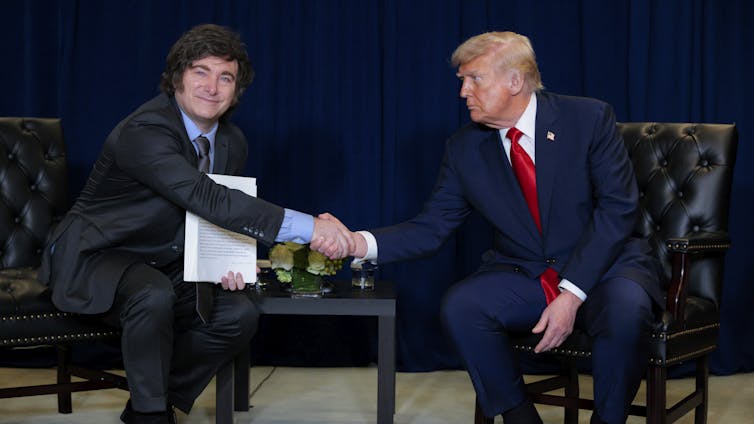
President Donald Trump vowed to help out his Argentine counterpart, Javier Milei, on Sept. 23, 2025, a day after the U.S. administration said “all options” were on the table in regard to a bailout for the Latin American country’s rocky economy.
A day after Trump and Milei’s meeting on the sidelines of the United Nations General Assembly in New York, U.S. Treasury Secretary Scott Bessent said he was prepared to lend Argentina up to US$20 billion via currency swaps and bond purchases.
But what caused Milei to go hat in hand to the U.S. in the first place? And what would a U.S. bailout of Argentina look like? For answers, The Conversation turned to Arturo Porzecanski, an expert on Latin American economies at American University.
Why is the Argentine government seeking a bailout?
The event that sparked discussion of U.S. intervention was a sharp sell-off of the Argentine currency, the peso, as well as the country’s stocks and bonds.
Over the course of three days ending on Sept. 19, the country’s central bank spent over $1 billion of its hard-currency reserves defending the Argentine peso from further depreciation. To be sure, instead of dialing up his contacts in the Trump administration, Milei could have allowed the currency to find its market-clearing value – that is, the price at which supply and demand match.
Alternatively, he could have continued to stabilize the peso by spending even more billions of dollars that had been previously borrowed from the International Monetary Fund.
However, he decided to call Washington and ask for financial support, hoping that the friendship with Trump he had been cultivating even before Milei was elected would finally pay off.
The Argentine authorities fear that a sharper depreciation will reignite expectations of high inflation, and they also wish to conserve those IMF funds to help cover nearly $20 billion in interest and principal payments on dollar debts coming due in the next 15 months. The Argentine government would also prefer not to have the central bank raise interest rates by tightening monetary policy further, nor implement additional cuts in government spending, given that the economy is either stagnant or already in recession.
Argentina’s economy deteriorated prior to Milei taking office in December 2023, as his predecessor had applied very loose monetary and fiscal policies – such as keeping interest rates low and spending high to stimulate the economy – as well as business-unfriendly regulations. That rocketed annual inflation into triple digits and led to the crumbling of confidence among domestic and foreign investors, thus complicating the government’s ability to refinance its maturing debt obligations.
While Milei reversed many of those harmful policies during 2024, notably achieving a balanced government budget and a sharp deceleration of inflation, his popular support and confidence in his ability to manage the country’s remaining challenges have weakened in recent months.
Tobias Skarlovnik/Getty Images
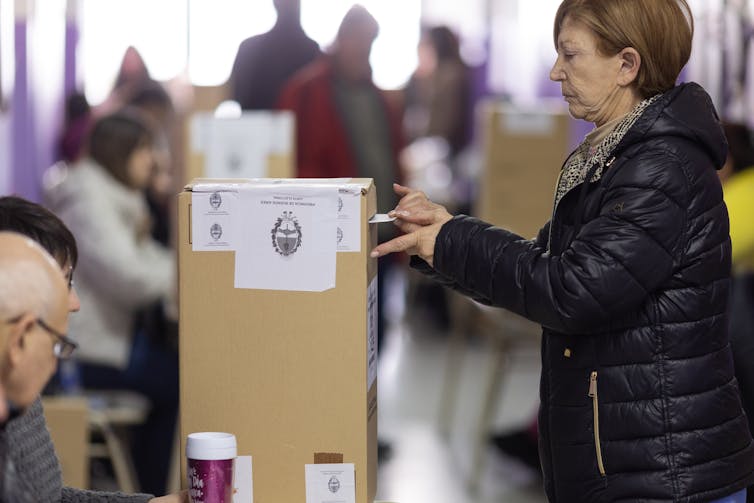
The economy has stalled, with job losses and unemployment rising. Phone recordings suggesting corruption involving the president’s family were released. Milei’s party did surprisingly poorly in recent elections held in the large province of Buenos Aires. With midterm congressional elections scheduled for November 2, Milei badly needs political and financial support from the Trump administration to stabilize the local financial markets and project a sense of stability.
What options are there for the US to help Argentina?
The U.S. government has already been unusually supportive of Argentina from its dominant positions on the board of directors of the IMF, World Bank, and Inter-American Development Bank. Earlier this year, it helped the country to secure pledges and disbursements worth tens of billions of dollars in new loans.
What is very new and different now is the prospect of direct lending from the U.S. Treasury to the government of Argentina. As previewed by Treasury Secretary Scott Bessent on September 24, his team is currently in negotiations with their counterparts in Argentina for a $20 billion swap line, which would presumably involve the Treasury’s temporary purchase of Argentine pesos in exchange for the delivery of U.S. dollars. This could possibly be supplemented by the Treasury’s temporary purchase of Argentine government bonds, likely payable in dollars, whether newly issued or already in circulation.
Bessent’s announcement, coming on the heels of Trump’s vow to help his Argentine counterpart, has prompted local and foreign investors to regain confidence in Argentina, such that beaten-down stocks and bonds have bounced back, and the currency has appreciated.
This immediate and enthusiastic market response, if sustained, means that the Treasury may not need to spend billions of U.S. dollars to boost public confidence in Milei and Argentina, at least until the upcoming midterm elections.
Should Milei’s party do well in the late-October contest, enabling it to gain seats in the House and Senate and thus have more political support in the national legislature, a relatively small and temporary investment may yield a worthwhile payoff for the Trump and Milei administrations.
Why is the US keen on helping out?
Typically, the U.S. government does not directly involve itself in foreign bailouts unless a country is systemically essential – namely, when its troubles affect its neighbors, several other countries, or the United States itself.
For example, in the 1990s, the U.S. Treasury provided direct support to other countries during crises in Mexico, East Asia, and Russia. In 1995, Argentina was one of the beneficiaries. And in 2008, in the wake of the global financial crisis, the Fed made available dollars in exchange for the currencies of about a dozen foreign countries – currency swaps mainly with European countries but also with Brazil, Canada, and Mexico, since the meltdown affected Washington’s North American neighbors and many nations in Europe.
Moreover, in most cases, any Treasury or Fed funding made available is soon repaid by upcoming loans from institutions such as the IMF and the World Bank, or by major banks or institutional investors. In other words, most U.S. official support has been of the “bridge lending” kind, because the Treasury and the Fed can act within days, whereas other financial actors require weeks or even months to approve and disburse funding.
In the case of Argentina, it is notable that Bessent has stated that Argentina is systemically important, even though its troubles have so far not affected any other country. Left unsaid is how Argentina would repay the U.S. Treasury, as the pipeline of upcoming disbursements from official international organizations is not substantial.
Therefore, the funds under discussion are not clear bridges to anything. In similar circumstances in the past, the U.S. Treasury has sought payment guarantees from foreign governments. Given the transactional approach favored by Trump, certain conditions may be demanded from Argentina – a country endowed with lithium, rare earths, shale oil, and other resources.
What is the US Treasury’s Exchange Stabilization Fund?
The Exchange Stabilization Fund is the Treasury’s crisis-funding vehicle through which the bridging loan to prop up the Argentine currency would be made.
The fund was established in the mid-1930s. It was endowed with the profits that the U.S. Treasury realized when the official price of gold rose from $20.67 to $35 per ounce, increasing the value of U.S. government gold holdings.
For several decades, from the 1980s onwards, specifically before the U.S. currency was allowed to float freely, the fund’s primary purpose was to provide funding for Treasury operations that affected the price of the dollar. A secondary purpose was to provide short-term, government-to-government loans, mainly to Latin American countries. However, starting in the mid-1990s, this became its primary objective.
The last Exchange Stabilization Fund loan was granted to Uruguay in mid-2002, following a major financial crisis in neighboring Argentina that had triggered a bank run in Uruguay and threatened to spread to other countries in the region. The Treasury sent $1.5 million to Uruguay on a Monday to back at least the government-owned banks, and the funds were returned to Washington that same Friday. The bank run was stopped, and thus the loan succeeded magnificently.
Arturo Porzecanski, Research Fellow, Center for Latin American & Latino Studies, American University
This article is republished from The Conversation under a Creative Commons license. Read the original article.



Comments are closed.