

Nordic Seas Overturning Circulation strengthens as Atlantic Meridional Overturning Circulation weakens
A new modelling study identifies a feedback mechanism suggesting that a strengthening of the Nordic Seas Overturning Circulation (NOC) could be a direct consequence of the Atlantic Meridional Overturning Circulation (AMOC) weakening from global warming, not a separate anomaly. The study was led by the Potsdam Institute for Climate Impact Research (PIK) in collaboration with the University of Bergen.
Updated April 24, first published January 7, 2026.
Iceland is the first country to declare climate-related issues a national security risk.
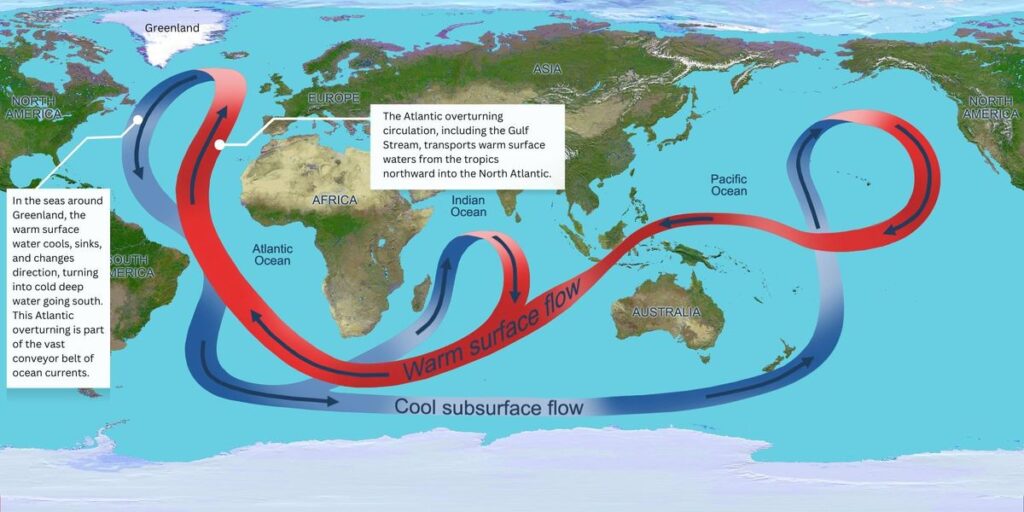
The Atlantic Meridional Overturning Circulation (AMOC) is an ocean current system that brings warmer waters from the tropics through the Arctic and into the North Atlantic Ocean, as well as colder waters south, which helps to regulate global climate.
Recently, experts have raised the possibility that the AMOC could collapse, which could make winters across Europe harsher and disrupt weather worldwide. These warnings have been brought to the attention of Iceland’s National Security Council, marking the first time a climate-related issue has been brought before the council, which is coordinating a response to the issue.
“It is a direct threat to our national resilience and security,” Icelandic Climate Minister Johann Páll Johannsson told Reuters. The Norwegian Ministry of Environment, meanwhile, told Reuters that it was seeking to deepen its understanding through new research.
This comes after Icelandic members of parliament attending the COP30 conference in Brazil last month focused on the dangers of the AMOC collapsing.
In addition to the effects the current has on the climate, the AMOC is also essential for marine life. The circulation carries nutrients, increases salinity, and brings oxygen to the deepest levels of the ocean. If circulation slowed or collapsed, it could, for example, reduce zooplankton populations, which would, in turn, affect the entire food system. Additionally, the circulation is essential in preventing further acidification in the ocean, helping shellfish, plankton, and corals build shells.
Scientific Alarm Bells
CTIF: The warning aligns with recent research from the University of Copenhagen, which suggests the AMOC could collapse between 2025 and 2095, with a central estimate around 2057. The study, published in Nature Communications, used statistical analysis of sea surface temperature patterns to predict tipping points. While some scientists caution that the models are uncertain, others argue that the risks are too great to ignore.
The study, led by Peter Ditlevsen and Susanne Ditlevsen, estimates with 95% confidence that the Atlantic Meridional Overturning Circulation (AMOC) could collapse between 2025 and 2095, with the most likely tipping point around 2057. The researchers used advanced statistical methods and 150 years of sea surface temperature data to identify early warning signals of instability in the AMOC system
In a separate investigation, Reuters reported that Icelandic volcanologists are also monitoring increased magma buildup beneath glaciers, possibly linked to climate-driven ice retreat.
Global Implications
A collapse of the AMOC would not be confined to the North Atlantic. It could shift tropical rain belts, disrupt agricultural zones, and accelerate sea level rise along the eastern seaboard of North America. The UK Met Office has warned that such a collapse could reduce rainfall in the Amazon and intensify heatwaves in Europe.



Comments are closed.