
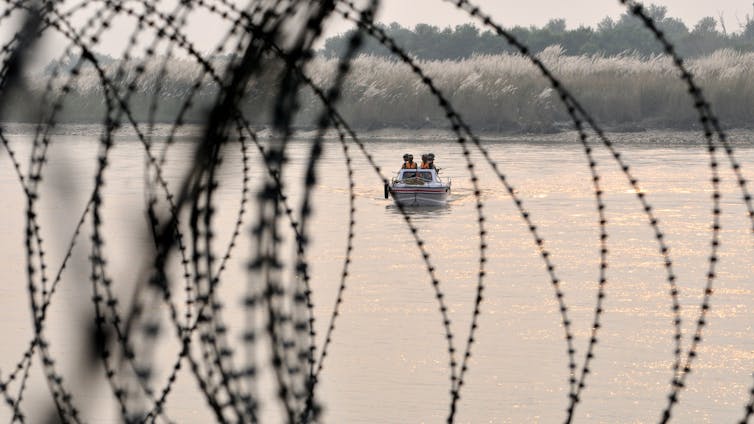
Nitin Kanotra/Hindustan Times via Getty Images
Pintu Kumar Mahla, University of Arizona
With the future of a crucial water-sharing treaty between India and Pakistan uncertain, one outside party is watching with keen interest: China.
For 65 years, the Indus Waters Treaty has enabled the two South Asian rivals to share access to and use of the Indus Basin, a vast area encompassed by the Indus River and its tributaries, which also extends into Afghanistan and China.
For much of that history, there has been widespread praise for the agreement as a successful demonstration of cooperation between adversarial states over a key shared resource. But experts have noted the treaty has long held the potential for conflict. Drafters failed to factor in the effects of climate change, and the Himalayan glaciers that feed the rivers are now melting at record rates, ultimately putting at risk the long-term sustainability of the water supply. Meanwhile, the ongoing conflict over Kashmir, where much of the basin is situated, puts cooperation at risk.
With the treaty on ice, China steps in
The latest provocation threatening the treaty was a terrorist attack in the Indian union territory of Jammu and Kashmir on April 22, 2025. In response to that attack, which India blamed on Pakistan and precipitated a four-day confrontation, New Delhi temporarily suspended the treaty.
But even before that attack, India and Pakistan had been locked in negotiations over the future of the treaty, the status of which has been in the hands of international arbitrators since 2016. In the latest development, on June 27, 2025, the Permanent Court of Arbitration issued a supplementary award in favor of Pakistan, arguing that India’s holding of the treaty in abeyance did not affect its jurisdiction over the case. Moreover, the treaty does not allow either party to suspend it unilaterally, the ruling suggested.
Amid the wrangling over the treaty’s future, Pakistan has turned to China for diplomatic and strategic support. Such support was evident during the conflict that took place following April’s terrorist attack, during which Pakistan employed Chinese-made fighter jets and other military equipment against its neighbor.
Meanwhile, in an apparent move to counter India’s suspension of the treaty, China and Pakistan have ramped up construction of a major dam project that would provide water supply and electricity to parts of Pakistan.
So, why is China getting involved? In part, it reflects the strong relationship between Pakistan and China, which has developed over the past six decades.
But as an expert in hydro politics, I believe Beijing’s involvement raises concerns: China is not a neutral observer in the dispute. Rather, Beijing has long harbored a desire to increase its influence in the region and counter an India that has long been seen as a rival. Given the at-times fraught relationship between China and India – the two countries went to war in 1962 and continue to engage in sporadic border skirmishes – there are concerns in New Delhi that Beijing may respond by disrupting the flow of rivers in its territory that feed into India.
In short, any intervention by Beijing regarding the Indus Waters Treaty risks escalating regional tensions.
Wrangling over waters
The Indus Waters Treaty has already endured three armed conflicts between Pakistan and India. Until recently, it served as an exemplar of how to forge a successful bilateral agreement between two rival neighbors.
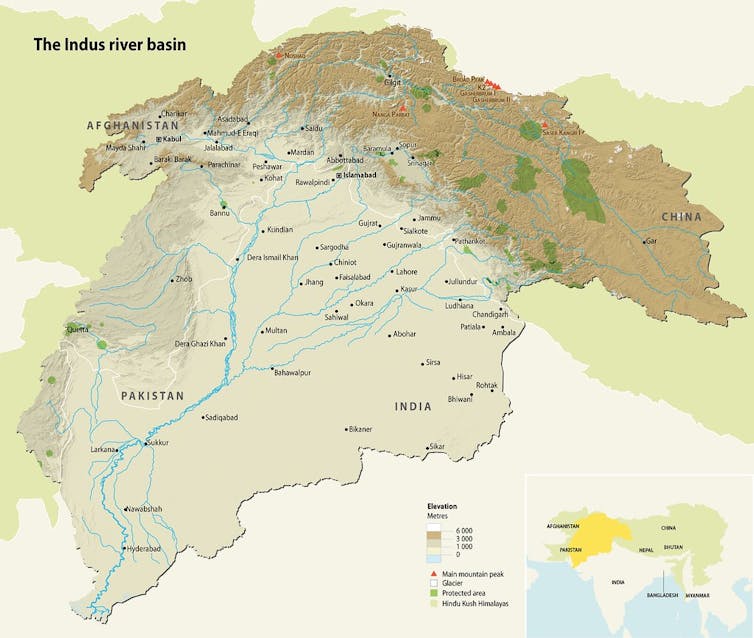
Under the initial terms of the treaty, which each country signed in 1960, India was granted control over three eastern rivers the countries share – Ravi, Beas, and Satluj – with an average annual flow of 40.4 billion cubic meters. Meanwhile, Pakistan was granted access to approximately 167.2 billion cubic meters of water from the western rivers – the Indus, Jhelum, and Chenab.
In India, the relatively smaller distribution has long been the source of contention, with many believing the treaty’s terms are overly generous to Pakistan. India’s initial demand was for 25% of the Indus waters.
For Pakistan, the terms of the division of the Indus Waters Treaty are painful because they concretized unresolved land disputes tied to the partition of India in 1947. In particular, the division of the rivers is framed within the broader political context of Kashmir. The three major rivers – Indus, Jhelum, and Chenab – flow through Indian-administered Jammu and Kashmir before entering the Pakistan-controlled western part of the Kashmir region.
But the instability of the Kashmir region, disputes around the Line of Control separating the Indian- and Pakistan-controlled areas are common, underscoring Pakistan’s water vulnerability.
Nearly 65% of Pakistanis live in the Indus Basin region, compared with 14% for India. It is therefore not surprising that Pakistan has warned that any attempt to cut off the water supply, as India has threatened, would be considered an act of war.
It also helps to explain Pakistan’s desire to develop hydropower on the rivers it controls. One-fifth of Pakistan’s electricity comes from hydropower, and nearly 21 hydroelectric power plants are located in the Indus Basin region.
Since Pakistan’s economy relies heavily on agriculture and the water needed to maintain agricultural land, the fate of the Indus Waters Treaty is of the utmost importance to Pakistan’s leaders.
Such conditions have driven Islamabad to be a willing partner with China in a bid to shore up its water supply.
China provides technical expertise and financial support to Pakistan for numerous hydropower projects, including the Diamer Bhasha Dam and the Kohala Hydropower Project. These projects play a significant role in addressing Pakistan’s energy requirements and have been a key aspect of the transboundary water relationship between the two nations.
Using water as a weapon?
With it’s rivalry with India and its desire to simultaneously work with Pakistan on numerous issues, China increasingly sees itself as a stakeholder in the Indus Waters Treaty, too. Chinese media narratives have framed India as the aggressor in the dispute, warning of the danger of using “water as a weapon” and noting that the source of the Indus River lies in China’s Western Tibet region.
Doing so fits Beijing’s greater strategic presence in South Asian politics. After the terrorist attack, China’s Foreign Minister Wang Yi reaffirmed China’s support for Pakistan, showcasing the relationship as an “all-weather strategic” partnership and referring to Pakistan as an “ironclad friend.”
In response to India’s suspension of the treaty, China announced that it would accelerate work on the significant Mohmand hydropower project, located on the tributary of the Indus River in Pakistan.
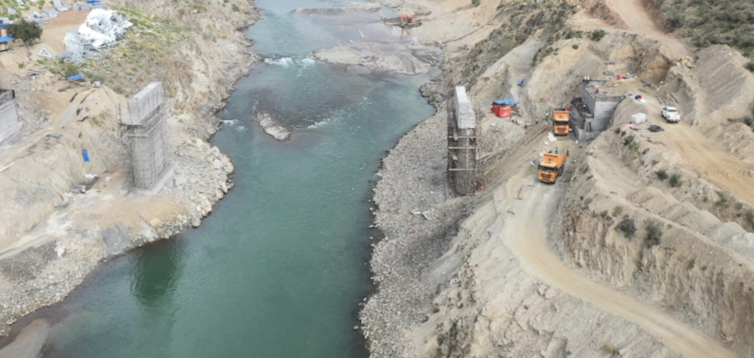
Chinese investment in Pakistan’s hydropower sector presents substantial opportunities for both countries in regards to energy security and promoting economic growth.
The Indus cascade project under the China-Pakistan Economic Corridor initiative, for example, promises to provide cumulative hydropower generation capacity of around 22,000 megawatts. Yet the fact that the project broke ground in Gilgit-Baltistan, a disputed area in Pakistan-controlled Kashmir, underscores the delicacy of the situation.
Beijing’s backing of Pakistan is largely motivated by a mix of economic and geopolitical interests, particularly in legitimizing the China-Pakistan Economic Corridor. However, it comes at the cost of exacerbating regional tensions.
As such, the alignment of Chinese and Pakistani interests in developing hydro projects can pose a further challenge to the stability of South Asia’s water-sharing agreements, especially in the Indus Basin. Recently, the chief minister of the Indian state of Arunachal Pradesh, which borders China, warned that Beijing’s hydro projects in the Western Tibet region amount to a ticking “water bomb.”
To diffuse such tensions – and to get the Indus Waters Treaty back on track – it behooves India, China, and Pakistan to engage in diplomacy and dialogue. Such engagement, I believe, is essential in addressing the ongoing water-related challenges in South Asia.
Pintu Kumar Mahla, Research Associate at the Water Resources Research Institute, University of Arizona
This article is republished from The Conversation under a Creative Commons license. Read the original article.



Comments are closed.