

The Burnham coup is complete.
Labour is never coming back.
Vote Green. pic.twitter.com/rfrLEuj7yO— Kerry Burgess (@KerryBurgess) July 26, 2026
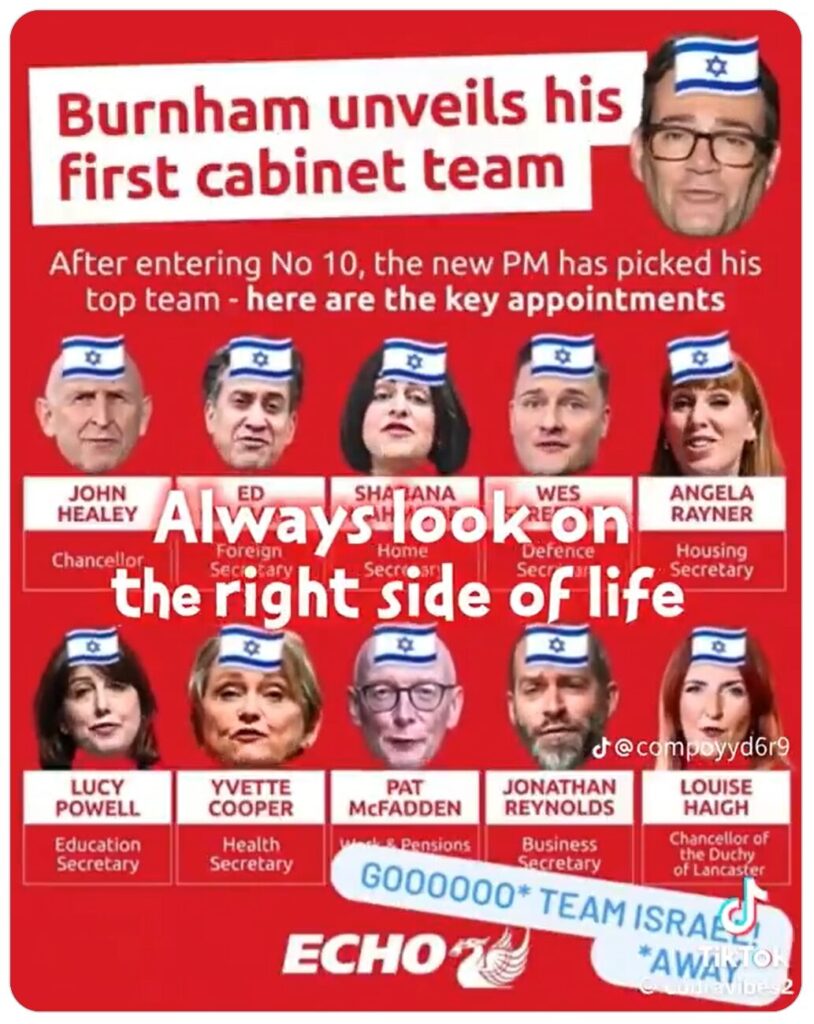
Burnham has been a member or supporter of the Labour Friends of Israel (LFI) group since at least 2015. In a 2015 leadership campaign, he stated that “he has always been a friend of Israel and the Jewish community- and that will never change” . He has also previously described Israel as a “democracy” and called the BDS (Boycott, Divestment, Sanctions) movement “spiteful”.
On his second day in office (Tuesday) @andyburnham helped the US bomb Iran.
Following his agreement, US bombers were allowed to take off for their strike mission from RAF Fairford in Gloucestershire. https://t.co/8Nybmxue4Z
— Declassified UK (@declassifiedUK) July 25, 2026
Andy Burnham’s last Labour leadership campaign was funded by Howard Borrington, then a director at arms firm MBDA.
In the Fahmi al-Jarjawi School attack of May 2025, the Israeli military dropped GBU-39 bombs fitted with MBDA Inc. folding wings.
18 children were killed. pic.twitter.com/5wB7liCvdB
— Jody McIntyre (@jodymcintyre_) June 15, 2026
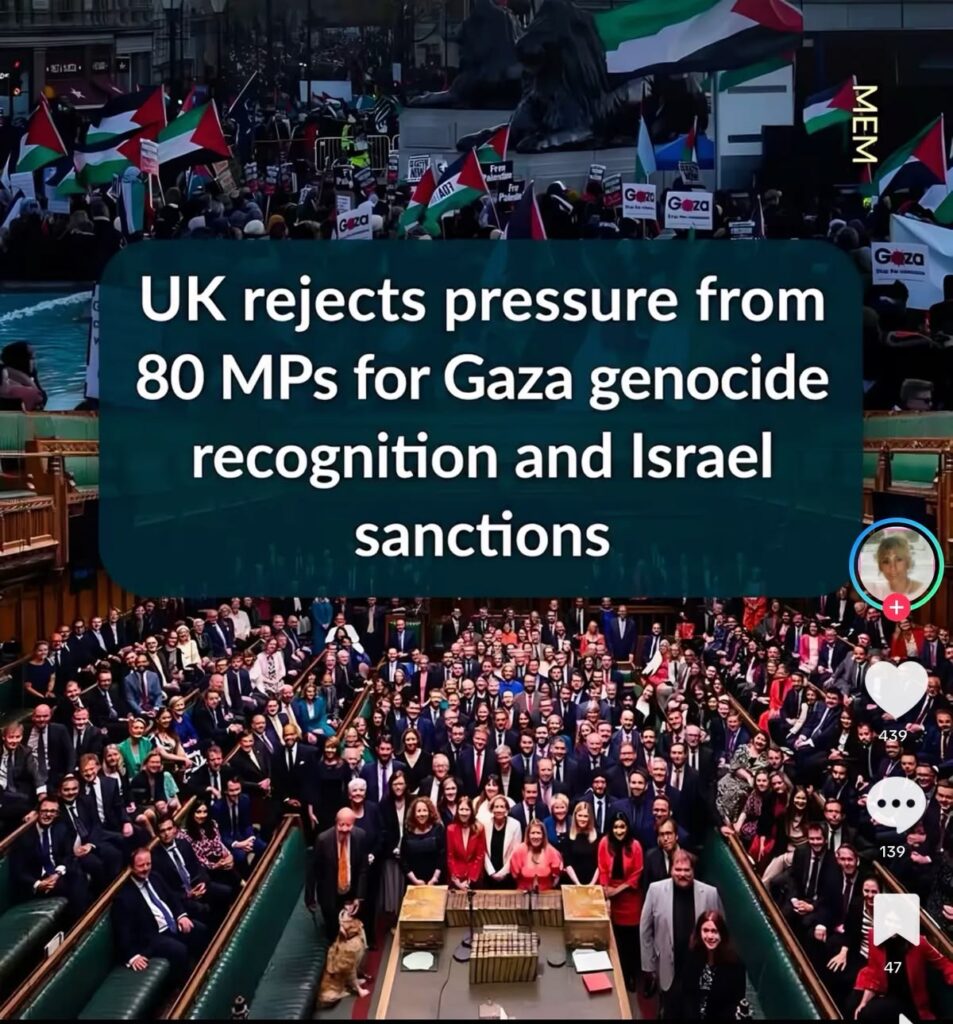
Burnham government are genocide enablers
Updated July 30, July 28, July 25, first published on July 17, 2026.
Andy Burnham is the Labour leader – third time lucky for the UK’s prime minister‑in‑waiting
Eric Shaw, University of Stirling
Andy Burnham has won on his third attempt to be Labour’s leader. In a wide-ranging speech to Labour MPs at a special conference in London, a jubilant Burnham pledged to “bring back hope” and promised to be a leader for all nations of the UK. But it has taken him well over a decade to get here. In 2010, as a rising star associated with the Blairite wing, he made his first bid for the leadership.
In truth, back then he had little prospect of success: he was merely placing a marker. Five years later, he stood again but could do little to derail the Jeremy Corbyn bandwagon. Yet fast-forward 11 years and his ascent seemed unstoppable. Next week, he will become the UK’s 59th prime minister.
To understand why and how this happened, the circumstances that created this opportunity for Burnham are key. In 2024 Labour returned to power with a thumping majority, but with little more than a third of the total vote. Within months the new government was lurching from crisis to crisis; its standing in the polls collapsed and Keir Starmer became the most unpopular prime minister since modern records began.
At the same time, the party faced powerful challenges from opposite ends of the political spectrum – the radical-right Reform UK and the left-wing Greens. Labour’s electorate was visibly disintegrating, its plight made stark by the disastrous local and devolved parliamentary elections of May 2026 when it shed huge numbers of local councillors and lost Wales for the first time in over a century. The message for the parliamentary Labour Party (PLP) was stark: virtually all of them were at risk of losing their seats.
In these circumstances speculation around a challenge to Starmer mounted. But why should a man twice rejected by the party so rapidly emerge as the sole contender for the crown? The key (though not sole) factors are Labour’s system for electing its leader, the balance of internal party alignments, the structure of competition and the personal factor.
In terms of the election procedures, in 2010 Labour’s leader was selected by an electoral college divided into three sections: MPs, party members and trade union political levy-payers.
This was replaced in 2013 by direct membership voting, with three categories of members – ordinary members, affiliated (trade union) members and registered supporters. (This is discussed in detail in my book, Order and Rebellion: Labour’s Managerial Politics from Miliband to Starmer, co-authored with Emmanuelle Avril). This was the system in 2015 when Corbyn swept the board across all three categories.
But by 2026 there had been two significant changes. First, the class of registered supporters had been abolished. Second, the nominations threshold for leadership contenders had been raised from 12.5% to 20% of the PLP. It is unlikely the former had much effect but the latter certainly did, by effectively blocking anyone from the hard left from entering. This benefited the soft left, where Burnham positions himself.
Soft-left membership
There are no really reliable estimates of the shifting balance of alignments within Labour’s membership. Gauging this is difficult because of massive turnovers in membership between 2010 and 2026. Most observers would agree that the membership shifted after 2015 and then to the right after 2020.
Paradoxically, the centre of gravity among the rank and file did not change dramatically. Close observers of the party agreed that the mean party members tended to be soft left. This is why Starmer contested the 2020 race on a soft left platform (soon abandoned). If Burnham had done likewise in 2015, he might have won.
The structure of competition in Burnham’s three contests differed considerably. In 2010 he was not a serious contender, with the race effectively between the Miliband brothers Ed and David. In 2015 there were four contestants: Burnham, Corbyn from the hard left, and Liz Kendall and Yvette Cooper from the right.
As a member of the shadow cabinet under Ed Miliband, Burnham had shifted to the left and was initially seen as the frontrunner. However, he made a fatal miscalculation in assuming that in response to the 2015 election defeat the party would move to the right and so he did so himself.
In fact, the party swung left and Corbyn was able to sweep up the leftwing vote – including those broadly on the soft left.
Burnham learned his lesson. After quitting parliament and winning the newly created post of mayor of Greater Manchester, he increasingly adopted a soft left posture. In the race to succeed Starmer, there were only three other plausible candidates: Angela Rayner and Ed Miliband from the soft left, and Wes Streeting from the right.
Here, chance intervened on Burnham’s side. The popular Rayner was forced to resign as deputy prime minister and deputy leader over a tax issue. Otherwise, she would probably have been in pole position. Like Rayner, Miliband, who worked closely with Burnham, was unwilling to stand against him since both shared his soft left stance. This left Streeting. His problem was simple: even if he mustered the 81 nominations he required, as a right-winger he had no chance of beating Burnham in a leadership contest. Streeting knew this, so opted not to stand.
Finally, among Burnham’s personal qualities, two are worth noting. The first is his undoubted popularity among those who know him best – his Greater Manchester constituents. More broadly, he normally receives a better net rating than any other Labour politician.
The second is his willingness to take a major risk by standing for a constituency, Makerfield, that he could easily have lost. Every one of its wards were won by Reform in the local elections and its demographics rendered it a top target for the party.
But Burnham’s unexpectedly decisive victory in the byelection demonstrated his mass appeal. For hundreds of beleaguered Labour MPs fearful of losing their seats, he was seen as their one and only lifeline. Burnham had staked his career on Makerfield and won.
This article features references to books that have been included for editorial reasons, and may contain links to bookshop.org. If you click on one of the links and go on to buy something from bookshop.org The Conversation UK may earn a commission.
Eric Shaw, Honorary Research Fellow in Politics, University of Stirling
This article is republished from The Conversation under a Creative Commons license. Read the original article.
Comments are closed.