


Most mainstream media have failed in their most bascic duty: they have largely manufactured consent, enabling a genocide in real time.
Francesca Albanese, UN Special Rapporteur on the Occupied Palestinian Territories
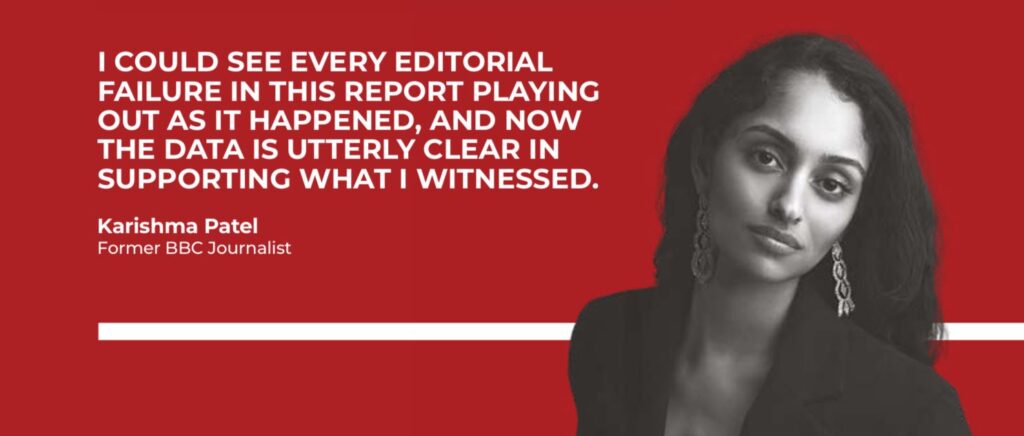
I could see every editorial failure in this report playing out as it happened, and now the data is utterly clear in supporting what I witnessed.
– Karishma Patel, Former BBC Journalist
Will the cowards at @BBCNews ever figure out who is killing Palestinians? 🤔 pic.twitter.com/lEWPjTIVPd
— ADAM (@AdameMedia) September 10, 2025
“Israel rejects the findings as Hamas falsehoods…”
The BBC giving Israel’s propaganda equal weight to a UN genocide report.
Shameful. pic.twitter.com/y1RmNiVVBz
— Hamza Yusuf (@Hamza_a96) September 16, 2025
The list of humanitarian institutions that accuse Israel of genocide now includes:
1. The UN
2. International Association of Genocide Scholars
3. B’Tselem (Israeli)
4. Physicians for Human Rights-Israel (Israeli)
5. Amnesty International
6. Doctors Without Borders
7. European Center for Constitutional and Human Rights
8. Human Rights Watch
9. International Federation for Human Rights
10. Lemkin Institute for Genocide Prevention
Centre for Media Monitoring’s new report concludes that the BBC is systematically biased against Palestinians in Gaza war coverage.
Analysis of 35,000+ pieces of BBC content shows Israeli deaths given 33 times more coverage, per fatality, and significantly more emotive language.
Key Findings:
- Palestinian deaths treated as less newsworthy: Despite Gaza suffering 34x more casualties than Israel, BBC gave Israeli deaths 33 times more coverage per fatality and ran almost equal numbers of humanising victim profiles (279 Palestinians vs 201 Israelis).
- Systematic language bias favouring Israelis: BBC used emotive terms 4 times more for Israeli victims, applied ‘massacre’ 18x more to Israeli casualties, and used ‘murder’ 220 times for Israelis vs once for Palestinians.
- Suppression of genocide allegations: BBC presenters shut down genocide claims in over 100 documented instances whilst making zero mention of Israeli leaders’ genocidal statements, including Netanyahu’s biblical Amalek reference.
- Muffling Palestinian voices: The BBC interviewed significantly fewer Palestinians than Israelis (1,085 v 2,350) on TV and radio, while BBC presenters shared the Israeli perspective 11 times more frequently than the Palestinian perspective (2,340 v 217).

View this post on Instagram
The most comprehensive analysis of the BBC’s coverage of Israel’s war on Gaza reveals a systematic pattern: the minimisation of Palestinian suffering and perspectives and the amplification of Israeli narratives, victimisation, and emotive stories.
The study, conducted by the Centre for Media Monitoring, analysed 3,873 articles and 32,092 broadcast segments from 7 October 2023 to 6 October 2024, alongside a comparative analysis of 7,748 articles on the Ukraine conflict. During the analysis period, 42,010 Palestinians and 1,246 Israelis were killed – a 34:1 ratio that provides crucial context for assessing the impartiality of the BBC’s coverage. It also used extensive case studies extending into 2025.
The report reveals a systematic omission of key historical and contemporary context that has acquired an institutional quality at the BBC. Whether this be overlooking the genocidal rhetoric of Israeli leaders – now referenced in war crimes charges against them – or properly scrutinising Israeli claims and denials in the face of ethnic cleansing and other war crimes, the BBC have simply underreported what is now overwhelmingly being seen as a ‘live-streamed genocide’ and crimes against humanity.
Rizwana Hamid, Director of the Centre for Media Monitoring said: “The BBC has a duty to reflect the full reality of this devastating war, including the lived experience of Palestinians. When language, framing, and editorial choices consistently favour one side, the public loses access to the truth. Our findings are based on evidence, not ideology — and we urge the BBC to reflect, engage, and reform.”
Alistair Campbell, co-presenter of the ‘Rest is Politics’ podcast said: “All too often, on domestic issues, the BBC’s response to criticism from the right is to accept rather than challenge it and adapt coverage accordingly. This is perhaps best understood in the context of the incessant drumbeat of anti-BBC sentiment in a commercially and politically motivated right-wing press. But we see the same pattern in some of its approach to international issues too, notably Israel and Palestine. The Israelis and the right-wing media do a very good job of persuading people that the BBC is biased in favour of Palestinians. This report suggests otherwise…at the leadership level, there seems to be a bias not against Israel but in favour of its talking points and the defence of its actions.”
Baroness Sayeeda Warsi, former co-chair of the Conservative Party said: “This powerful research by the Centre for Media Monitoring exposes how, during Israel’s war on Gaza, the BBC consistently prioritised Israeli pain and perspective – at the expense of Palestinian lives and voices…..This is no cherry-picked critique. It is a comprehensive, evidence-based indictment that cannot be ignored. If the BBC is to maintain any claim to impartiality, it must now engage seriously with these findings and the recommendations that follow.”

1 Comment
Pingback: 10 Institutions Accuse Israel of Genocide in Gaza - Bergensia